Cantilever Logo
    Home
    Features
    Blogs
    About Us
    Log In
    Career

    What a Data Engineer Actually Builds in Production

    9 min read
    Jul 12, 2026
    What a Data Engineer Actually Builds in Production

    The Myth of the 'Simple ETL Developer' – What Data Engineers Actually Do

    The role of a data engineer is often misunderstood as simply writing straightforward ETL (Extract, Transform, Load) scripts. However, this perception couldn't be further from the truth. In reality, data engineers are responsible for designing, building, and maintaining complex production pipelines that must handle messy, unpredictable data. According to Medium, most data pipelines fail in production not because of some dramatic, unforeseeable crash, but because they were designed for ideal, 'happy path' conditions, not the messy reality of production. They fail because of silent errors, unexpected schema changes, and flawed architecture that can't handle being rerun. Silent errors—where a pipeline appears to succeed but produces incorrect data—are particularly dangerous because they are hard to detect until downstream consumers report issues. This means the pipeline assumes perfect data, clean input, and no unexpected interruptions. Data engineers must instrument their pipelines with monitoring and alerting to catch these failures early, and they must design for retries, backfills, and idempotency—adding layers of complexity far beyond simple ETL. Understanding this distinction is the first step toward building pipelines that survive production.

    In the next sections, we will delve deeper into the realities of data engineering and explore the complexities of production pipelines, the business impact of pipeline downtime, and the strategies for handling schema changes and scaling pipeline architectures.

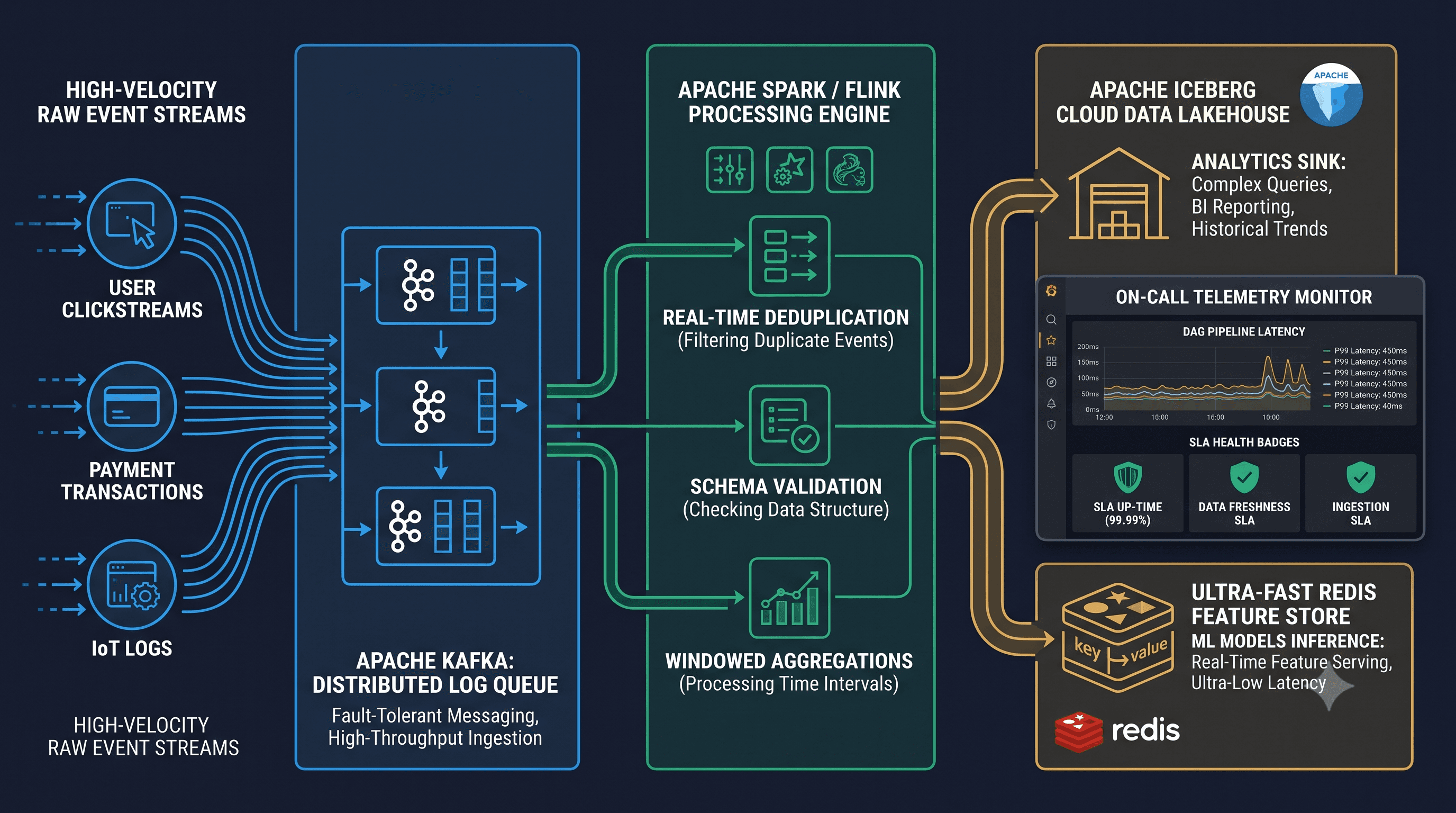
    Production Pipelines: 24/7 Operations and On-Call Reality

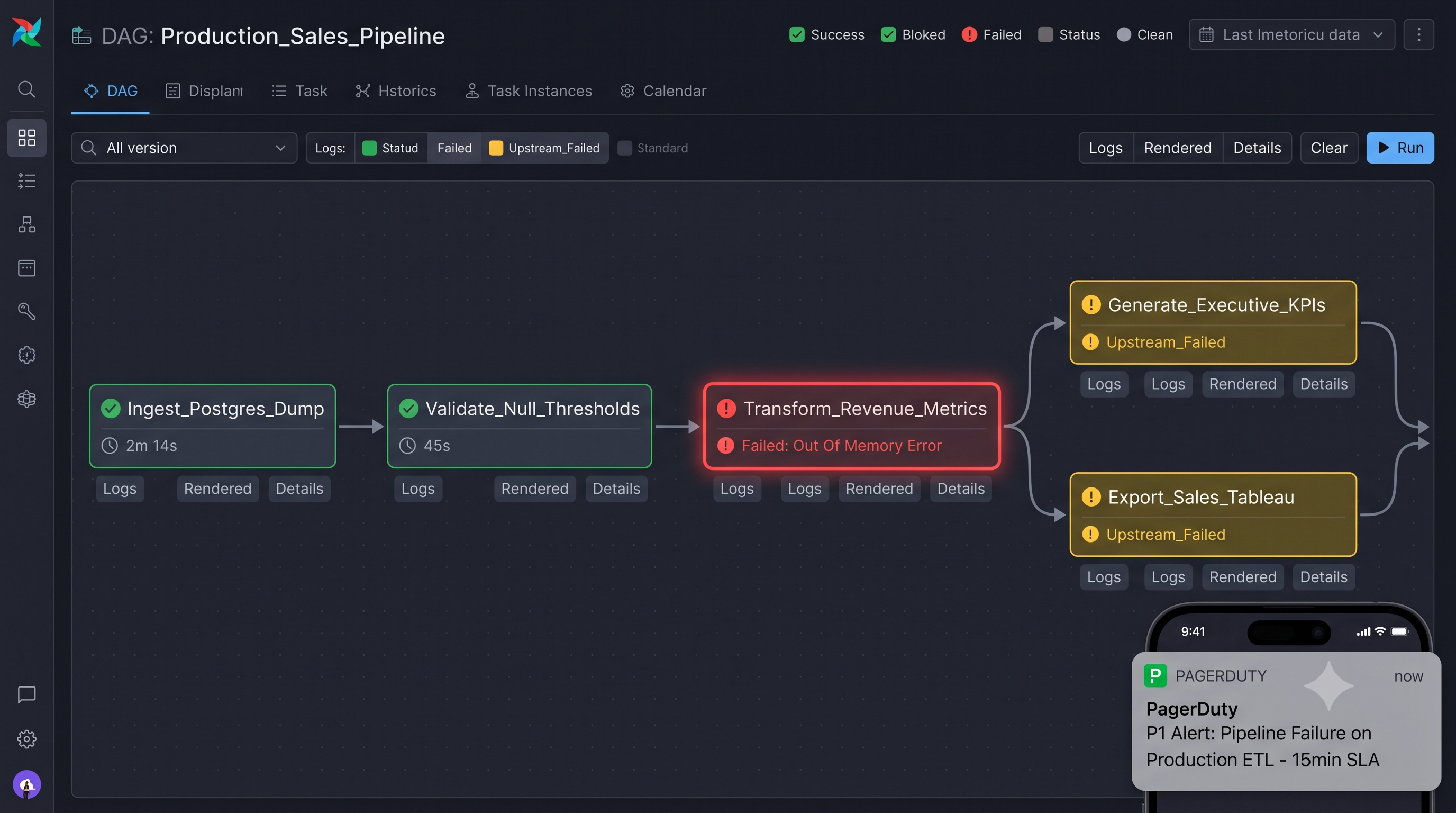
    Data engineers are often perceived as working behind the scenes, but the reality is far more demanding. They write code that runs 24/7, serving analytics dashboards, machine learning models, and operational applications simultaneously. When a pipeline fails at 2 a.m. a data engineer gets the alert — not a data scientist. This on-call reality is a critical aspect of the role, often overlooked in job descriptions. Common alerts include data quality checks, schema mismatch errors, and pipeline stall warnings, each requiring immediate diagnosis and fix. Data engineers often have to coordinate with upstream data producers to resolve issues, requiring cross-team communication. As a result, data engineering teams invest heavily in runbooks, automated recovery, and post-mortem reviews to reduce mean time to resolution. Given that the average enterprise experiences 4.7 pipeline failures per month (as detailed in the next section), on-call engineers can expect frequent disruptions. Data scientists, by contrast, rarely face such production pressure, focusing instead on model experimentation and analysis. This distinction is why data engineering is a distinct discipline, not a junior version of data science.

    Comparing Expected vs Actual Responsibilities

    This on-call reality means data engineers must be prepared for disruptive alerts and continuous monitoring—a far cry from the insulated role many imagine.

    Diagram of 24/7 production data pipeline with on-call monitoring and alerting system
    Diagram of 24/7 production data pipeline with on-call monitoring and alerting system

    The Business Impact: Pipeline Downtime Costs $3 Million Monthly

    The financial impact of pipeline downtime is substantial, with large enterprises facing an estimated ₹25 crore (approximately $3 million USD) in average monthly business exposure, according to the Fivetran Enterprise Data Infrastructure Benchmark Report 2026 Fivetran Report. This significant cost is a direct result of pipeline failures, which can have far-reaching consequences for organizations.

    Quantifying the Urgency for Robust Data Engineering Practices

    The urgency for robust data engineering practices is underscored by the frequency and duration of pipeline failures. On average, enterprises manage over 300 pipelines and experience 4.7 failures per month. Each incident takes nearly 13 hours to resolve, indicating a significant impact on engineering resources. In fact, 53% of engineering capacity is devoted to maintaining and troubleshooting pipelines, highlighting the need for more efficient and reliable data engineering practices.

    Pipeline Downtime Cost and Frequency Statistics

    MetricValue
    Average monthly business exposure₹25 crore (~$3 million USD)
    Number of pipelines managedOver 300
    Average failures per month4.7
    Time to resolve failuresNearly 13 hours
    Percentage of engineering capacity devoted to maintenance and troubleshooting53%
    Percentage of respondents reporting pipeline failures slowed analytics or AI programs53%

    These statistics emphasize the critical need for robust data engineering practices to minimize pipeline downtime and its associated costs. By investing in reliable and efficient data engineering solutions, organizations can mitigate the financial impact of pipeline failures and ensure the smooth operation of their analytics and AI programs.

    Schema Changes: The #1 Cause of Downtime (and How to Handle Them)

    Schema changes are a critical aspect of data pipeline management, yet they often lead to downtime and significant financial losses. According to industry reports, 48% of engineers report schema issues as the leading cause of downtime Rakuten SixthSense Blog. Companies experience an average of 3 hours of downtime per schema failure, costing thousands in lost productivity.

    Failure MetricPercentage/ Average
    Engineers reporting schema issues as leading cause of downtime48%
    Average downtime per schema failure3 hours
    Data pipelines with weekly orchestration delays37%
    Organizations facing monthly data pipeline failures62%

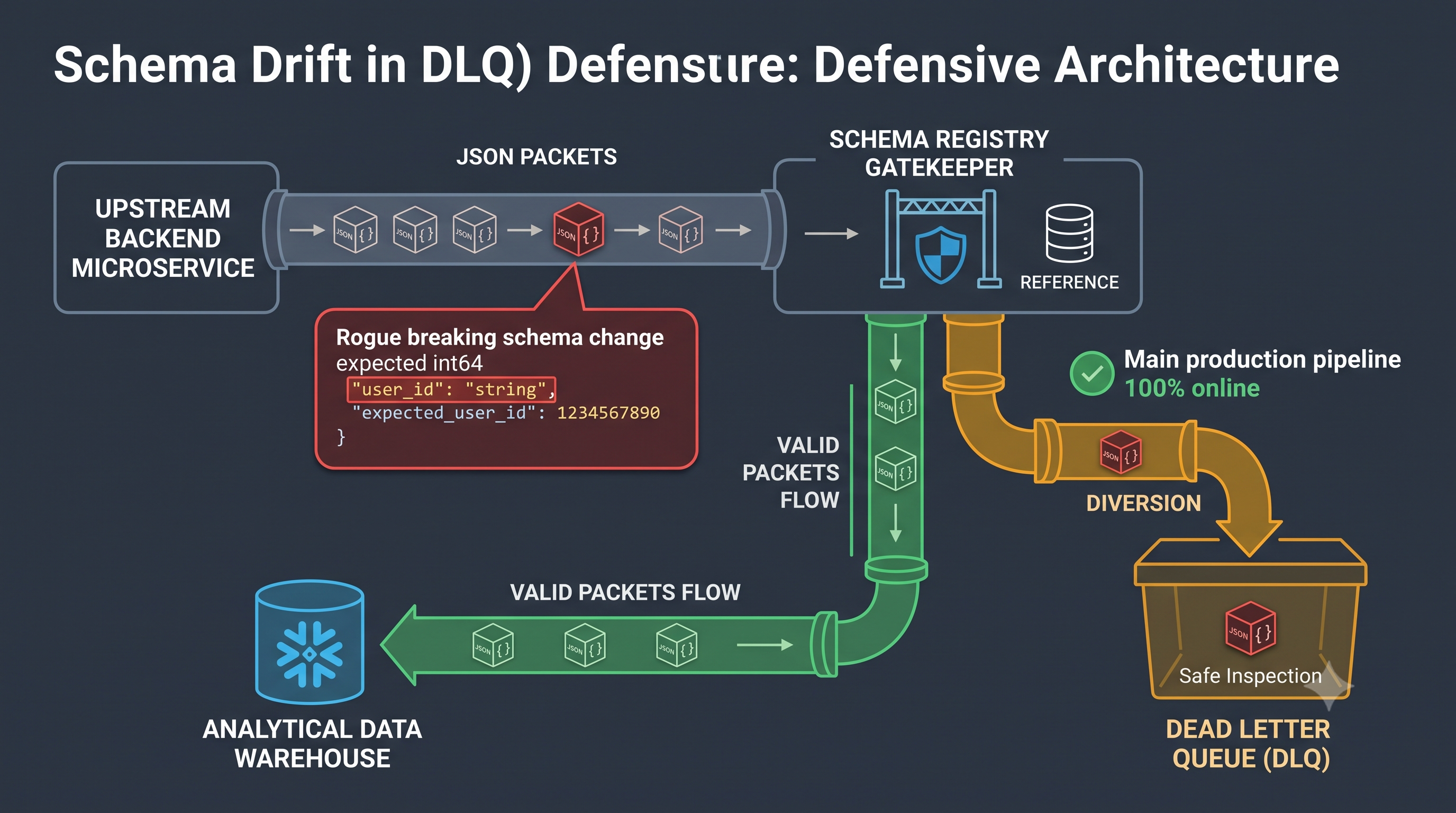
    With such high costs, effective strategies are essential. Version control for schema changes involves storing schema definitions in Git, allowing teams to review changes in pull requests and roll back if needed. Automated testing can include schema validation tests that check for new columns, removed columns, or altered data types before deployment. Gradual rollouts (e.g. canary deployments) limit the blast radius by applying changes to a small subset of pipelines first. Additionally, using a schema registry decouples producers and consumers, allowing them to evolve independently while maintaining compatibility. Monitoring schema drift with automated alerts can catch changes early before they cause cascading failures. Ensuring backward compatibility (e.g. adding columns as nullable, never removing columns without deprecation cycles) is a key principle. By adopting these practices, organizations can reduce the 48% of downtime caused by schema issues.

    Knowledge Check

    What is the primary benefit of implementing version control for schema changes?

    By understanding the causes and consequences of schema changes, organizations can take proactive steps to mitigate their impact and improve overall data pipeline reliability.

    Visualization of schema change causing pipeline cracks and data fragmentation
    Visualization of schema change causing pipeline cracks and data fragmentation

    Scaling from 10 to 50 Pipelines: Dependency Chain Fragility

    As companies scale from 10 to 50 production pipelines within a 12-month period, dependency chain fragility becomes a primary challenge. Pipeline count outpaces architectural planning, leading to increased frequency and blast radius of cascade failures. In a monolithic architecture, a single pipeline failure can ripple through dependent pipelines, causing downstream failures that are hard to trace. Microservice architectures isolate failures, but they introduce complexity in orchestration and data consistency.

    Consider a company with 50 pipelines: a failure in the main data ingestion pipeline (monolithic) affects all downstream transformation, aggregation, and reporting pipelines, potentially taking down the entire data warehouse. In a microservice architecture, only the ingestion service fails, and dependent pipelines can still process historical data or use cached results. Proactive architectural planning involves mapping dependencies, defining service boundaries, and implementing fallback mechanisms. Resilience patterns such as circuit breakers, retries with exponential backoff, and dead-letter queues become critical at scale. Without this planning, data engineering teams spend increasing amounts of time fire-fighting—the Fivetran report notes that 53% of engineering capacity is devoted to maintenance and troubleshooting, a number that grows with pipeline count. Choosing the right architecture mitigates cascade risks, but proactive planning—evaluating growth trajectory and the current pipeline landscape—is essential to avoid reactive fixes that increase technical debt.

    Real-World Example: Fintech Fraud Detection – Streaming vs ETL

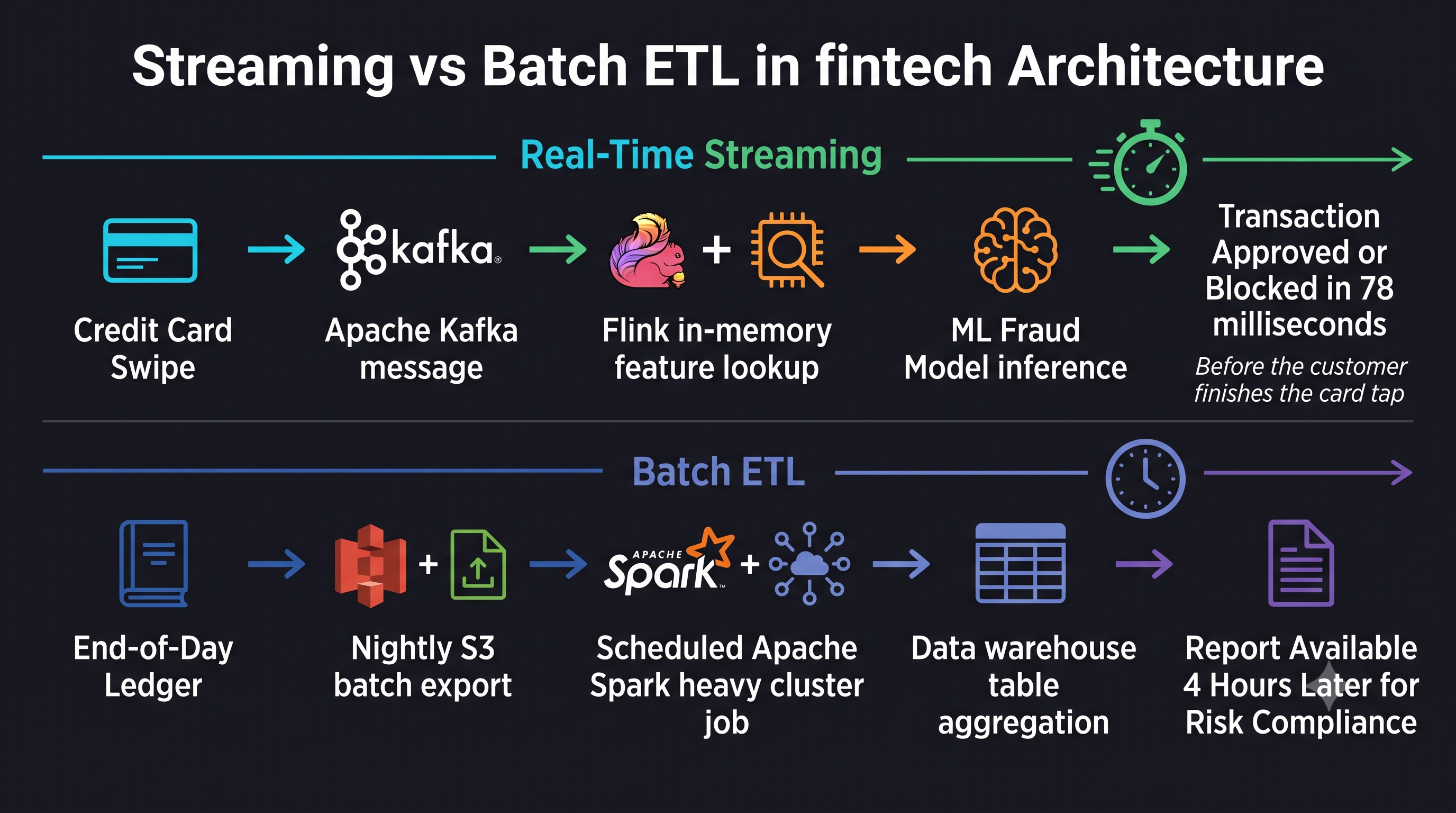
    In fintech data architecture, fraud detection systems face a critical challenge: evaluating each transaction in under a second while ensuring accuracy. This is achieved by comparing transactions against models trained on hundreds of contextual signals. The architecture of such systems typically involves two key components: streaming and ETL (Extract, Transform, Load).

    Streaming is used for real-time evaluation and decision-making, such as determining whether to approve a transaction. This requires processing transactions as they occur, often using complex event processing and machine learning models. On the other hand, ETL handles post-incident analysis and compliance reporting, which involves batch processing and analyzing large datasets.

    The use of streaming in fraud detection allows for immediate action, preventing potential losses. For instance, a system can instantly flag a transaction that deviates significantly from a user's normal spending pattern. In contrast, ETL is better suited for thorough analysis and reporting, which is essential for regulatory compliance and understanding trends.

    When designing a fraud detection system, data engineers must consider the trade-offs between these two approaches. Streaming offers speed and agility but requires sophisticated real-time processing capabilities. ETL, while slower, provides a more comprehensive view of the data, which is crucial for long-term analysis and compliance.

    Understanding the strengths and limitations of each is crucial for building effective fraud detection systems. This involves evaluating factors such as data volume, velocity, and the need for real-time decision-making.

    Infographic comparing streaming and ETL pipeline speeds for fraud detection
    Infographic comparing streaming and ETL pipeline speeds for fraud detection

    Frequently Asked Questions

    What does a data engineer actually do that differs from a simple ETL developer?

    Data engineers don’t just write ETL scripts—they build and maintain production pipelines that run 24/7, serving analytics dashboards, ML models, and operational applications simultaneously. Unlike the simple ETL developer myth, real data engineering involves handling silent errors, unexpected schema changes, and on-call rotations where a 2 a.m. pipeline failure alerts the engineer, not a data scientist. The job is fundamentally about designing for messy production conditions, not just happy-path transformations.

    How bad is pipeline downtime and why should I care about its cost?

    Pipeline downtime at large enterprises creates an estimated $3 million in average monthly business exposure, according to the Fivetran Enterprise Data Infrastructure Benchmark Report. Over 97% of respondents said pipeline failures had slowed analytics or AI programs, and the average enterprise manages over 300 pipelines, experiencing 4.7 failures per month—each taking nearly 13 hours to resolve. This means 53% of engineering capacity is consumed by maintenance and troubleshooting, making reliability a critical skill for any serious data engineer.

    What is the #1 cause of pipeline downtime in production?

    Schema changes are the leading cause of downtime, with 48% of engineers reporting schema issues as their top reliability headache. Each schema failure results in an average of 3 hours of downtime, costing thousands in lost productivity. Because pipelines are designed for ideal conditions, a silent schema change (e.g. a new column, removed field, or altered data type) can cascade into failures that are hard to detect until dashboards break or models produce garbage results.

    How do streaming and ETL differ in real-world use cases like fraud detection?

    In fintech fraud detection, streaming pipelines must evaluate each transaction in under a second by comparing it against models trained on hundreds of contextual signals—streaming decides whether to approve the transaction in the moment. ETL, on the other hand, handles post-incident analysis and compliance reporting by batch-processing historical data. This distinction highlights why data engineers need to choose the right architecture: streaming for real-time decisions, ETL for thorough, replayable analytics.

    Table of Contents

    • 1. The Myth of the 'Simple ETL Developer' – What Data Engineers Actually Do
    • 2. Production Pipelines: 24/7 Operations and On-Call Reality
    • 3. The Business Impact: Pipeline Downtime Costs $3 Million Monthly
    • 4. Schema Changes: The #1 Cause of Downtime (and How to Handle Them)
    • 5. Scaling from 10 to 50 Pipelines: Dependency Chain Fragility
    • 6. Real-World Example: Fintech Fraud Detection – Streaming vs ETL
    • 7. Frequently Asked Questions
    Build ATS Friendly Resume
    Check Resume ATS Score
    Industry Level Projects
    Interview Playbook
    Dream Company Track

    Build ATS Friendly Resume

    Use our AI Resume builder to tailor your resume with 10+ ATS Friendly templates.

    Check Resume ATS Score

    Find and fix hidden issues and gaps instantly to make sure your resume survives recruiter filters.

    Industry Level Projects

    Explore a curated project library personalized to your role and resume to bridge skills gap.

    Interview Playbook

    Master your preparation with our famous frameworks to prepare for your next interview.

    Dream Company Track

    Follow a step-by-step prep roadmap tailored around the hiring process of your target company.

    Keep Reading

    View all
    The 2026 Forward Deployed Software Engineer Roadmap: From Backend Developer to High-Impact Client Deployments
    01
    Career

    The 2026 Forward Deployed Software Engineer Roadmap: From Backend Developer to High-Impact Client Deployments

    Discover the 2026 roadmap from backend dev to forward deployed engineer. Master system design and hybrid cloud to land FDE roles at Palantir and C3.ai.

    15 min read•Career Module
    What Does an AI Engineer Actually Build? RAG Pipelines, Fine-Tuning, and Production Architecture
    02
    Career

    What Does an AI Engineer Actually Build? RAG Pipelines, Fine-Tuning, and Production Architecture

    AI engineers build RAG pipelines, fine-tuned models, and retrieval systems. Learn what the role actually involves with data and interview insights.

    14 min read•Career Module
    4 System Design Mistakes Freshers Make in Interviews
    03
    Interview Prep

    4 System Design Mistakes Freshers Make in Interviews

    Learn the four critical system design mistakes freshers make in interviews and discover structured approaches to ace your next technical interview.

    12 min read•Interview Prep Module
    4th Floor, Bizness Square, Opp. Hitex Charminar, Hitec City, Hyderabad - 500081
    (684) 555-0102
    Site Map
    Home
    About Us
    Features
    Blogs
    Others
    Privacy Policy
    Terms and Conditions
    Careers
    Media Coverage
    Subscribe to get latest updates
    Follow us on:
    ©2026 Cantilever Labs Pvt. Ltd. | info@cantileverlabs.com