


01
Resume
Pasting your GitHub link — Why recruiters never click it
Discover why recruiters ignore your GitHub link and learn how to transform your profile into a tie-breaker that lands you more interviews.
12 min read•Resume Module
The initial review of a resume is an important moment in the hiring process. A 2018 eye-tracking study by Ladders reported that recruiters spent an average of 7.4 seconds on an initial resume screening pass. This figure describes one study's observed screening behavior, not a universal time limit for every recruiter or application.
The finding highlights why clear formatting, relevant experience, readable section headings, and concise accomplishments matter during an initial review.
Recruiters do not read resumes thoroughly; instead, they scan for role fit. This scanning process is often facilitated by Applicant Tracking Systems (ATS) that filter resumes based on specific criteria. The ATS resume scan is a crucial step, as it determines whether a candidate's resume will even be seen by a recruiter.
To make it past the ATS and into the hands of a recruiter, a resume must be optimized for the specific job description. This involves using relevant keywords, clear formatting, and concise language. A well-crafted resume should immediately convey a candidate's qualifications, experience, and potential for the role.
The pressure to quickly identify suitable candidates forces recruiters to prioritize efficiency. They are not looking for a comprehensive read of a candidate's entire background but rather a snapshot of their relevance to the position. This approach streamlines the hiring process, allowing recruiters to focus on the most promising candidates.
In this high-stakes environment, understanding the mechanics of ATS and the priorities of recruiters can significantly enhance a candidate's chances of advancing in the hiring process. By tailoring their resume to align with the requirements of the job and ensuring it is optimized for ATS scans, candidates can increase their visibility and improve their chances of securing an interview.

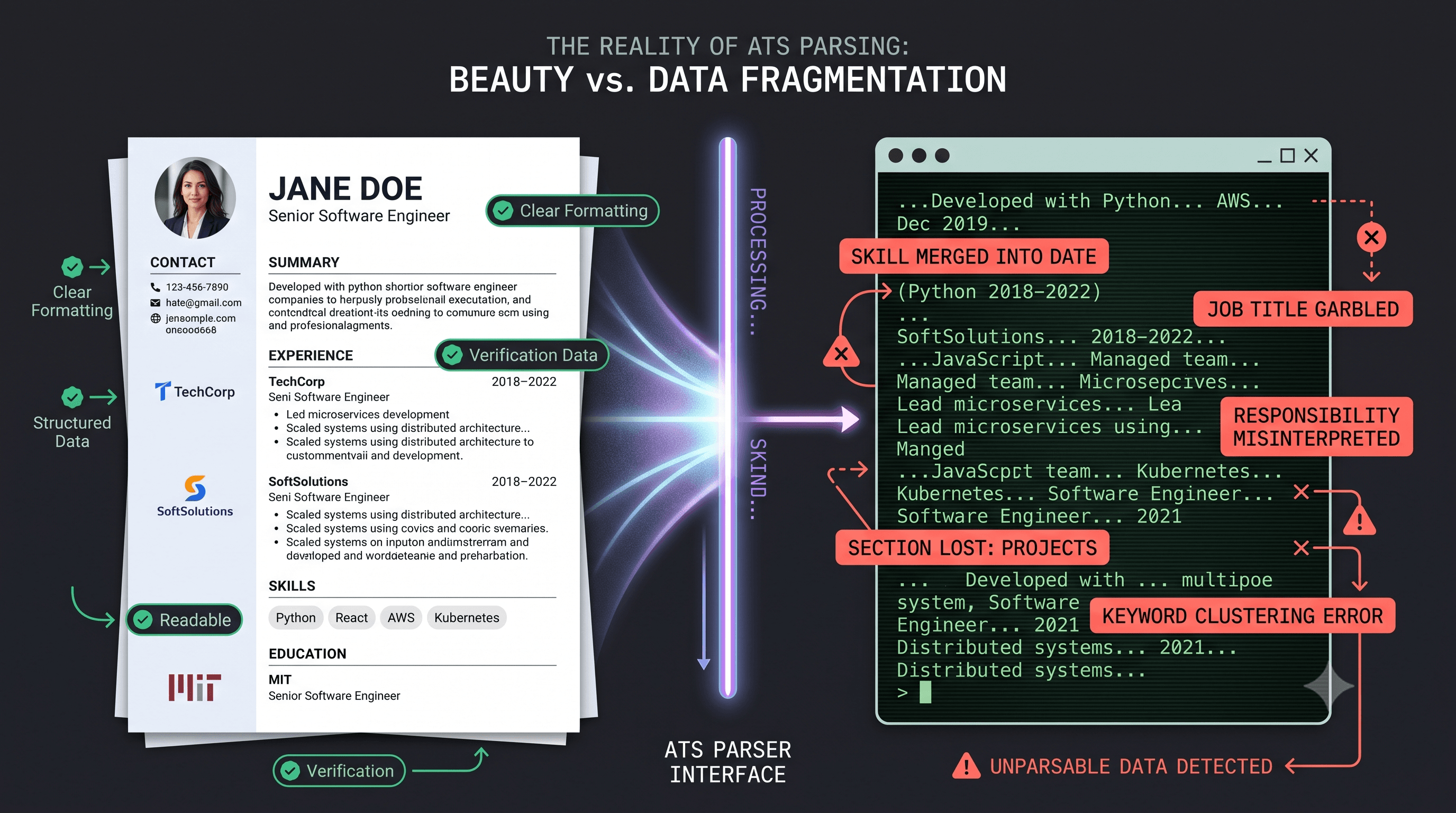
The parsing stage is a critical step in the resume screening process, where applicant tracking systems (ATS) analyze and extract relevant information from resumes. However, a significant number of resumes fail to pass this stage due to formatting issues, section headers, fonts, and column layouts. According to a study by ATSChecker, which analyzed 2,417 anonymized resumes between January and May 2026, 62% of resumes have formatting issues, and the average job-specific match score is only 58/100 [atschecker].
The study by ATSChecker also found that enterprise ATS platforms fail to parse nearly one in four resumes correctly. The breakdown of parsing failure types includes:
To improve the chances of passing the parsing stage, it is essential to optimize resumes for ATS. This includes using standard fonts, clear section headers, and a simple layout.
By understanding the common parsing failure types and optimizing resumes accordingly, job seekers can increase their chances of passing the parsing stage and getting their resumes in front of hiring managers.
When it comes to optimizing a resume for Applicant Tracking Systems (ATS), a strategic approach to keyword usage is crucial. The ATS keyword scoring algorithm is designed to evaluate the presence, placement, and context of keywords, ultimately determining a candidate's suitability for a position.
The presence score, ranging from 0 to 2, reflects the frequency of a keyword in a resume. However, this score alone is not sufficient for optimal ranking. The placement of keywords also plays a significant role, with the ATS applying a multiplier based on the section in which the keyword appears. For instance, keywords listed in the Skills/Tools section receive a 1.2 multiplier, while those in the Summary section receive a 1.1 multiplier, and those in the Experience section receive a 1.0 multiplier [JobWizard].
To further enhance keyword scoring, context is essential. The ATS takes into account the context in which a keyword is used, particularly when accompanied by measurable outcomes. A context multiplier of 1.2 is applied when a bullet point includes a quantifiable outcome, significantly impacting the overall score.
By strategically incorporating keywords, optimizing their placement, and including measurable outcomes, candidates can significantly improve their ATS scores. This, in turn, increases their chances of getting shortlisted and eventually landing an interview. Industry practices suggest that a well-crafted keyword strategy can make all the difference in a competitive job market.
The impact of keyword optimization is evident when comparing the effectiveness of different sections in a resume. A keyword listed in the Skills/Tools section, for example, receives a higher placement multiplier than one listed in the Experience section. Similarly, a keyword accompanied by a measurable outcome can significantly enhance the context multiplier, leading to a higher overall score.
To maximize the effectiveness of a keyword strategy, it is essential to understand the ATS scoring algorithm and its various components. By doing so, candidates can tailor their resumes to optimize their keyword presence, placement, and context, ultimately improving their chances of success in a competitive job market.
The evolution of Applicant Tracking Systems (ATS) has significantly impacted how resumes are parsed and evaluated. Traditional rule-based parsers, which once dominated the industry, have given way to more sophisticated machine learning (ML) models and, more recently, Large Language Models (LLMs). This shift has brought about substantial improvements in accuracy.
Legacy rule-based parsers, which relied on predefined rules to extract information from resumes, typically achieved accuracy rates of around 65%. The introduction of early ML models improved this figure to approximately 85%. However, these models still struggled with complexities such as varied formatting, section headers, and fonts.
The advent of LLM-era parsers has marked a significant leap forward, with accuracy rates soaring to 97%. This substantial improvement can be attributed to the advanced capabilities of LLMs in understanding context, handling complex layouts, and learning from vast amounts of data.
An independent evaluation in 2025 measured the accuracy of commercial parsing tools, reporting a baseline F1 score of 0.817 on a dataset of 13,100 real resumes. This figure is notably lower than the advertised accuracy rates, highlighting the discrepancy between vendor benchmarks and real-world performance.
Further insights from the EMNLP 2025 ResumeBench study, which tested 24 LLMs on structured resume extraction, reveal that while these models perform well, they still face challenges. Specifically, GPT-4o struggles with multi-column layouts and cross-lingual structure, and code-specialized models perform worse than generalist models.
The progression from rule-based parsers to LLM-era parsers has significantly enhanced the accuracy of ATSs in evaluating resumes. As the technology continues to evolve, it is crucial for job seekers and employers to understand these advancements and their implications on resume parsing and evaluation.
When it comes to job applications, a well-crafted resume can make all the difference. With 54% of candidates sending the same generic resume to every job, it's no wonder that tailoring your resume to the job description can give you a significant edge. According to recent statistics, tailoring your resume to the job description makes you 6 times more likely to land an interview [Coversentry].
One major hurdle in getting past the initial screening is the Applicant Tracking System (ATS). These systems are designed to parse and rank resumes based on relevance to the job description. However, 66% of ATS systems cannot understand synonyms, which means that using the right keywords is crucial. For example, using "Project Management" instead of "Program Management" could make a significant difference.
To maximize your chances of getting past the ATS and in front of a human, it's essential to use job description keywords with context and outcomes. This means carefully reading the job description and incorporating relevant keywords into your resume, especially in your summary, skills section, and work experience. However, it's not just about stuffing your resume with keywords; you need to use them in context and demonstrate the outcomes of your work.
So, how can you tailor your resume for every job? Here are some actionable tips:
Recruiters spend a median of just 7.4 seconds on an initial resume review, according to a 2018 TheLadders eye-tracking study. With an average corporate job posting attracting 250 applications and only 4–6 candidates interviewed, your resume must pass both the ATS parser and the recruiter’s quick scan. That means clean formatting, strategic keyword placement, and measurable outcomes are critical to survive the 6-second window.
62% of resumes have formatting issues that cause them to fail at the parsing stage, and enterprise ATS platforms still fail to parse nearly one in four resumes correctly. To avoid this, use a single-column layout, standard section headings (e.g. “Experience,” “Education”), and avoid tables, text boxes, or graphics. Stick to common fonts like Arial or Calibri and save your file as a .docx rather than a PDF unless the job description explicitly requests PDF.
ATS keyword scoring uses a presence score (0–2), a placement multiplier (x1.2 for Skills/Tools, x1.1 for Summary, x1.0 for Experience), and a context multiplier (x1.2 if a bullet includes a measurable outcome). Simply copying keywords isn’t enough—66% of ATS cannot understand synonyms, so “Project Management” and “Program Management” are treated as different terms. You must use the exact phrasing from the job description and pair keywords with quantified achievements to outperform similar candidates.
Yes—54% of candidates send the same generic resume to every job, but tailoring your resume to the specific job description makes you 6× more likely to land an interview. This is because ATS algorithms reward keyword presence, placement, and context, and a generic resume typically scores only 58/100 on job-specific match. Investing 15–20 minutes per application to align your skills, tools, and outcomes with the posting can dramatically increase your callback rate.
Discover why recruiters ignore your GitHub link and learn how to transform your profile into a tie-breaker that lands you more interviews.

Discover the three most common resume formatting errors that break ATS parsers and learn how to fix them for better job application success.
Discover the real trade-offs of ATS-friendly resumes: parsing pitfalls, myth-busting stats, and data-driven strategies to boost your callback rate in Indian ...


