Cantilever Logo
    Home
    Features
    Blogs
    About Us
    Log In
    Preparation

    How a Vector Database Finds Similar Items Under the Hood

    10 min read
    Jul 12, 2026
    How a Vector Database Finds Similar Items Under the Hood

    Myth: Vector Databases Are Just Magic Black Boxes That Automagically Find Similar Items

    Reality: Vector Databases Rely on Specific Indexing Algorithms

    The notion that vector databases are "magic black boxes" stems from a lack of understanding about the underlying indexing algorithms that power these systems. In reality, vector databases rely on sophisticated algorithms to efficiently search and retrieve similar items. Two popular indexing algorithms used in vector databases are HNSW (Hierarchical Navigable Small World) and IVFFlat (Inverted File Flat). These algorithms have distinct trade-offs, and understanding their differences is crucial for effective use of vector databases.

    HNSW and IVFFlat: A Comparison

    HNSW and IVFFlat are both designed to efficiently search for similar vectors in high-dimensional spaces. However, they differ in their approach:

    • HNSW is a graph-based index that constructs a hierarchical graph to facilitate fast and efficient searching. It is known for its high recall and ability to absorb inserts without requiring a full rebuild.
    • IVFFlat, on the other hand, is an inverted file index that uses a flat indexing approach to store and search vectors.

    When choosing between HNSW and IVFFlat, consider the trade-offs between recall, memory usage, build time, and query performance.

    HNSW

    IVFFlat

    Recall
    Typically high; depends on index parameters and workload
    Depends on nlist/nprobe and workload
    Memory Usage
    2-5x more than IVFFlat
    Lower than HNSW
    Insert Performance
    Absorbs inserts without rebuilds
    Requires periodic rebuilding

    Understanding the Trade-Offs

    When selecting an indexing algorithm for a vector database, it's essential to consider the trade-offs between recall, memory usage, and insert performance. HNSW offers high recall and efficient insertion, but at the cost of higher memory usage. IVFFlat, on the other hand, provides lower memory usage but may require periodic rebuilding and has lower recall.

    Quiz: Understanding Indexing Algorithms

    Test your understanding of the fundamental differences between HNSW and IVFFlat:

    Knowledge Check

    What is the primary advantage of HNSW over IVFFlat?

    Myth: All Vector Compression Techniques Are Equally Effective

    Reality: Product Quantization (PQ) and Scalar Quantization (SQ) Have Different Trade-Offs

    The myth that all vector compression techniques are equally effective stems from a lack of understanding of the different techniques available and their varying trade-offs. Two popular techniques, Product Quantization (PQ) and Scalar Quantization (SQ), are often used for vector compression but work differently and have distinct advantages and disadvantages.

    Product Quantization (PQ) is a technique that splits vectors into subspaces and quantizes each subspace independently. This approach enables high compression ratios, up to 64x, but can make distance calculations less efficient, particularly for SIMD (Single Instruction, Multiple Data) operations. On the other hand, Scalar Quantization (SQ) compresses each vector component from float32 to int8, achieving a 4x compression ratio with minimal accuracy loss.

    Comparison of PQ and SQ

    Compression TechniqueCompression RatioSpeedAccuracy Impact
    Product Quantization (PQ)Up to 64xSlower due to non-SIMD-friendly distance calculationsHigher due to independent subspace quantization
    Scalar Quantization (SQ)4xFaster with SIMD-friendly operationsLower with <1% error per Qdrant experiments

    When choosing a vector compression technique, it is essential to consider the trade-offs between compression ratio, speed, and accuracy impact. While PQ offers higher compression ratios, SQ provides faster and more accurate results. Understanding these differences is crucial for selecting the most suitable technique for a specific use case.

    By considering these factors and selecting the appropriate technique, developers can optimize their vector compression and achieve better performance in their applications.

    Comparison of PQ and SQ compression techniques in vector databases
    Comparison of PQ and SQ compression techniques in vector databases

    Myth: All Vector Databases Perform Similarly Under Load

    Reality: Vector Database Performance Varies Significantly Under Load

    The myth that all vector databases perform similarly under load stems from a lack of comprehensive benchmarking and understanding of the underlying architectures. In reality, the performance of vector databases can vary significantly based on factors such as ingestion and query architecture.

    When evaluating vector databases, it's essential to consider latency metrics, including p50, p95, and p99. These metrics provide insight into the distribution of query performance, which is critical for applications requiring low-latency responses.

    Performance Comparison of Qdrant, Milvus, Weaviate, and Pinecone

    A recent benchmark ailog.fr evaluated Qdrant, Milvus, Weaviate, and Pinecone at 10M vectors (1536 dimensions) and reported

    Qdrant

    Milvus

    p50 Latency
    4.8ms
    7.2ms
    p95 Latency
    12.3ms
    18.9ms
    p99 Latency
    18.1ms
    28.4ms

    The results show that Qdrant outperforms Milvus, Weaviate, and Pinecone in terms of latency, with p50, p95, and p99 latencies of 4.8ms, 12.3ms, and 18.1ms, respectively. Milvus, Weaviate, and Pinecone trail behind, with Pinecone exhibiting the highest latency.

    When choosing a vector database, consider not only latency metrics but also memory usage. The benchmark reported the following memory usage per million vectors: Qdrant 1.42 GB, Milvus 1.87 GB, Weaviate 1.61 GB.

    By understanding the performance differences between vector databases, developers can make informed decisions when selecting a suitable database for their use case.

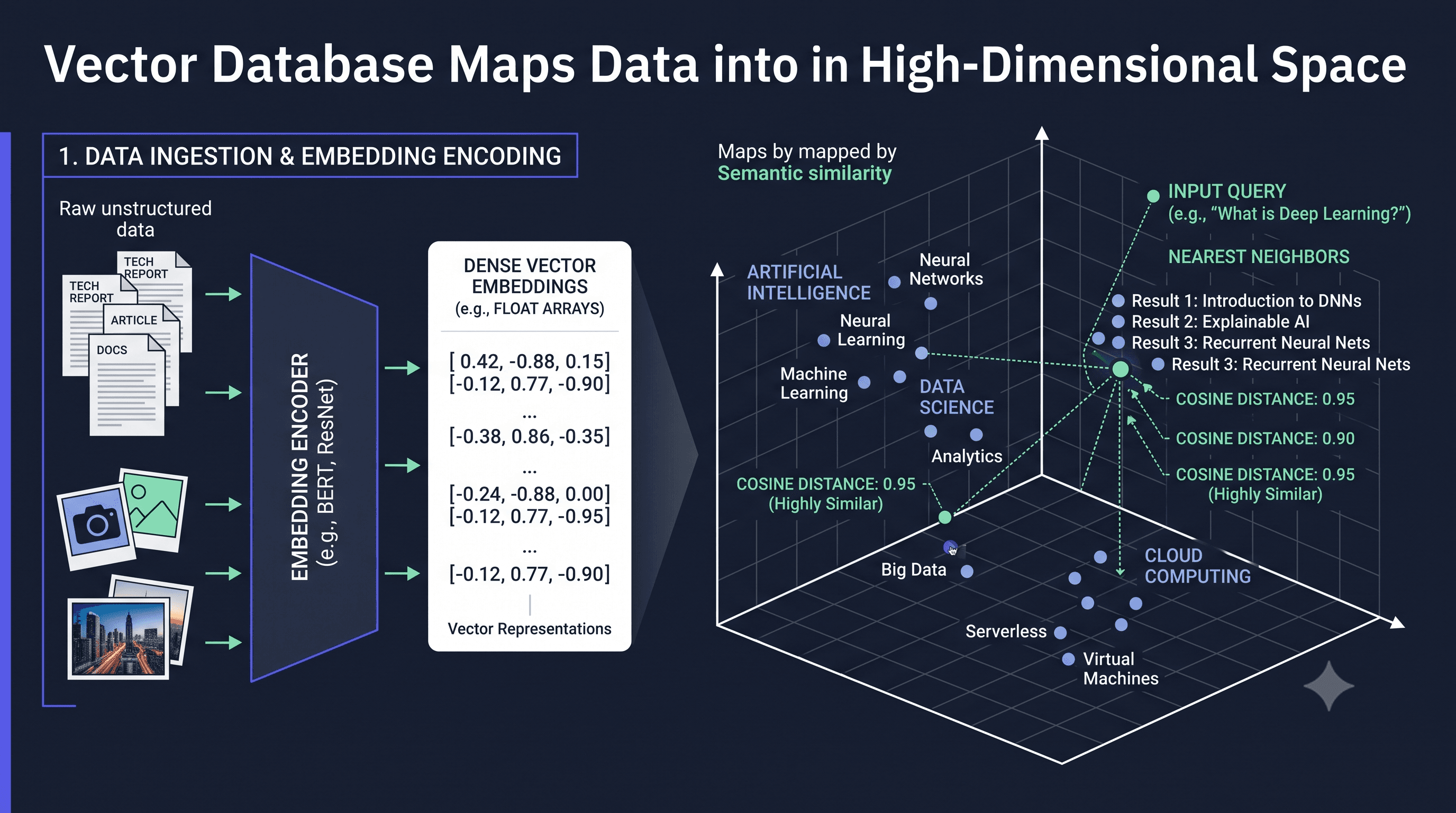
    Myth: HNSW Is the Best Algorithm for Every Vector Search Use Case

    Reality: HNSW offers high recall but consumes more memory and isn't always optimal.

    The HNSW (Hierarchical Navigable Small World) algorithm is widely used for vector search due to its high recall and efficiency. However, it is not the best choice for every use case. HNSW's performance is highly dependent on its parameters, which can significantly affect memory usage, build time, and search quality.

    HNSW's parameters, including M, efConstruction, and efSearch, play a key role in determining its performance. M controls graph connectivity, influencing memory, build work, and search quality. efConstruction controls build-time exploration, with larger values building a better graph at higher cost. efSearch controls query-time candidate breadth, increasing it improves recall while increasing latency.

    Despite its strengths, HNSW may not always be the best choice. For instance, Google's ScaNN achieves roughly 2x query throughput at a given accuracy compared to other libraries, and demonstrates higher Recall@1 for a fixed latency budget versus HNSW or IVF-PQ implementations, ScaNN is particularly effective for inner-product search and uses anisotropic vector quantization to improve search efficiency while maintaining high accuracy.

    ParameterEffect on MemoryEffect on Build TimeEffect on Search Quality
    MIncreases memory usageIncreases build timeImproves search quality
    efConstructionIncreases memory usageIncreases build timeImproves search quality
    efSearchMinimal impactMinimal impactImproves recall, increases latency

    When choosing a vector search algorithm, consider the specific requirements of your use case. If high recall is crucial and memory usage is not a concern, HNSW may be a suitable choice. However, if you need a balance between recall, latency, and memory usage, or if you're working with inner product searches, ScaNN or other algorithms may be more suitable. While HNSW is a powerful algorithm for vector search, it is not the best choice for every use case. Carefully evaluate your requirements and consider alternative algorithms like ScaNN to ensure the best performance for your specific use case.

    HNSW graph indexing structure for efficient vector search
    HNSW graph indexing structure for efficient vector search

    Myth: Vector Database Architecture Doesn't Matter – It's All the Same Under the Hood

    Myth: Vector Database Architecture is Irrelevant to Performance

    Many believe that the underlying architecture of a vector database does not significantly impact performance, as long as the database supports basic operations like indexing and querying. However, this is far from the truth.

    Reality: Architecture Choices Significantly Impact Performance

    The architecture of a vector database plays a key role in determining its performance, scalability, and usability. One key architectural decision is whether to use separate nodes for ingestion and querying or to serve both purposes from the same nodes.

    Separate Ingestion and Query Nodes

    Milvus, a popular open-source vector database, adopts an architecture where ingestion and querying are handled by separate node types. This design reduces the interaction between ingestion and query loads, improving overall system performance and scalability Milvus Blog.

    Shared Nodes for Ingestion and Querying

    In contrast, Qdrant, another popular vector database, serves both ingestion and querying from the same nodes. While this approach can simplify the architecture, it may lead to performance bottlenecks and increased latency under heavy loads.

    Impact of IVF Index Tuning

    Another critical aspect of vector database architecture is the tuning of IVF (Inverted File) indexes. IVF is a technique used to accelerate similarity searches in high-dimensional spaces. The performance of IVF indexes is heavily influenced by parameters such as:

    • nlist: The number of clusters to group similar vectors into. A higher nlist value can improve search accuracy but increases indexing time.
    • nprobe: The number of clusters to search during query time. Increasing nprobe improves recall but at the cost of higher latency.
    • spherical centroids: Using spherical centroids can improve performance when the metric is cosine similarity.

    Optimally tuning these parameters is crucial to achieving the right balance between search performance, recall, and latency Kodesage Blog.

    Quiz: Impact of Architecture Separation and IVF Tuning Parameters

    Knowledge Check

    What is the primary benefit of using separate nodes for ingestion and querying in a vector database?

    By understanding the impact of architecture choices and IVF tuning parameters, developers can design and deploy vector databases that meet their specific use case requirements and performance expectations.

    Frequently Asked Questions

    Is HNSW always the best vector index for every use case?

    No. HNSW can deliver high recall and supports incremental inserts without requiring a full index rebuild in many implementations, but its memory usage and build time are typically higher than IVFFlat. On a pgvector benchmark with 58k records, HNSW took ~30-81 seconds to build versus ~15 seconds for IVFFlat, though HNSW query latency was ~1.5ms compared to IVFFlat's ~2.4ms. Choose HNSW when query speed and recall matter most; choose IVFFlat when memory and build time are constrained.

    How do product quantization (PQ), scalar quantization (SQ), and binary quantization differ in practice?

    PQ splits vectors into subspaces and quantizes each independently, enabling up to 64x compression, but its distance calculations are not SIMD-friendly and therefore slower than SQ. SQ compresses each float32 component to int8, achieving 4x compression with minimal accuracy loss—error under 1% in Qdrant experiments. Binary quantization reduces each component to one or two bits for up to 32x compression, but suffers a much steeper decay in recall metrics.

    Does vector database architecture really affect performance under load?

    Yes, significantly. In a 10M vector benchmark with 1536 dimensions, Qdrant achieved p50 latency of 4.8ms while Pinecone lagged at 12.3ms, and memory per million vectors ranged from 1.42GB for Qdrant to 1.87GB for Milvus. Architecture choices also matter: Milvus separates ingestion and query nodes to reduce load interaction, whereas Qdrant serves both from the same nodes. These differences directly impact throughput, latency, and scalability under concurrent workloads.

    What index parameters should you tune to balance recall and latency?

    For HNSW, M controls graph connectivity, efConstruction controls build-time exploration, and efSearch controls query-time candidate breadth—increasing efSearch improves recall but raises latency. For IVF, set nlist to at least 4√N (default 1000) and nprobe to 10 by default; increasing nprobe improves recall at the cost of higher latency. When using cosine similarity, for cosine-similarity workloads, spherical clustering can be useful because it accounts for the angular nature of the similarity metric.

    Table of Contents

    • 1. Myth: Vector Databases Are Just Magic Black Boxes That Automagically Find Similar Items
    • 2. Myth: All Vector Compression Techniques Are Equally Effective
    • 3. Myth: All Vector Databases Perform Similarly Under Load
    • 4. Myth: HNSW Is the Best Algorithm for Every Vector Search Use Case
    • 5. Myth: Vector Database Architecture Doesn't Matter – It's All the Same Under the Hood
    • 6. Frequently Asked Questions
    Build ATS Friendly Resume
    Check Resume ATS Score
    Industry Level Projects
    Interview Playbook
    Dream Company Track

    Build ATS Friendly Resume

    Use our AI Resume builder to tailor your resume with 10+ ATS Friendly templates.

    Check Resume ATS Score

    Find and fix hidden issues and gaps instantly to make sure your resume survives recruiter filters.

    Industry Level Projects

    Explore a curated project library personalized to your role and resume to bridge skills gap.

    Interview Playbook

    Master your preparation with our famous frameworks to prepare for your next interview.

    Dream Company Track

    Follow a step-by-step prep roadmap tailored around the hiring process of your target company.

    Keep Reading

    View all
    LLM Evals or Unit Tests? — Why Your CI Pipeline Is Lying
    01
    Preparation

    LLM Evals or Unit Tests? — Why Your CI Pipeline Is Lying

    Discover why treating LLM evaluations like unit tests creates false security in CI/CD pipelines. Learn regression-testing discipline and metric validation...

    12 min read•Preparation Module
    How a GraphQL Resolver Fetches Data Under the Hood
    02
    Preparation

    How a GraphQL Resolver Fetches Data Under the Hood

    Understand how GraphQL resolvers fetch data, the N+1 problem's real impact, and how DataLoader with batching and caching solves it in production.

    12 min read•Preparation Module
    Building Autonomous AI Agents from Scratch: The 5-Stage Production Roadmap & Python Code
    03
    Preparation

    Building Autonomous AI Agents from Scratch: The 5-Stage Production Roadmap & Python Code

    Learn to build production-grade autonomous AI agents from scratch. This 5-stage roadmap covers orchestration, reliability, and Python code for Indian...

    13 min read•Preparation Module
    4th Floor, Bizness Square, Opp. Hitex Charminar, Hitec City, Hyderabad - 500081
    (684) 555-0102
    Site Map
    Home
    About Us
    Features
    Blogs
    Others
    Privacy Policy
    Terms and Conditions
    Careers
    Media Coverage
    Subscribe to get latest updates
    Follow us on:
    ©2026 Cantilever Labs Pvt. Ltd. | info@cantileverlabs.com