


01
Preparation
How a GraphQL Resolver Fetches Data Under the Hood
Understand how GraphQL resolvers fetch data, the N+1 problem's real impact, and how DataLoader with batching and caching solves it in production.
12 min read•Preparation Module
The increasing reliance on Large Language Models (LLMs) in various applications has led to the adoption of evaluation metrics to assess their performance. However, treating LLM evaluations as unit tests can be misleading. Unlike traditional software unit tests, LLM behavior can be stochastic and is highly context-dependent, making evaluations less deterministic than conventional unit tests. This distinction is crucial, as it impacts how evaluations are designed and interpreted.
LLM evaluations in Continuous Integration/Continuous Deployment (CI/CD) pipelines are often treated as deterministic unit tests. However, LLM behavior is shaped by a multitude of factors, including prompts, retrieval layers, system instructions, tool access, and the evaluation set itself [nhimg.org]. This complexity makes it challenging to design evaluations that accurately reflect real-world performance.
A passing score on an LLM evaluation does not guarantee that the model is functioning as intended. It can hide regressions in safety, reliability, or data handling if the test harness is not governed like production code. For instance, a model may perform well on a specific evaluation set but fail when faced with out-of-distribution inputs or adversarial examples.
To mitigate these risks, evaluation artefacts must be versioned, reproduced, and linked to release decisions. This ensures that evaluations are transparent, reproducible, and accountable. By treating LLM evaluations as a critical component of the development process, teams can increase confidence in their models and reduce the risk of deploying under-tested or faulty models. While LLM evaluations are essential for assessing model performance, they should not be treated as traditional unit tests. By acknowledging the non-deterministic nature of LLMs and the limitations of passing scores, teams can design more effective evaluations that provide a comprehensive understanding of model behavior.

Optimizing for evaluation scores has become a common practice in the development of Large Language Models (LLMs). However, this approach can breed false confidence, leading teams to overlook significant performance gaps that affect user satisfaction. The issue arises from the fact that evaluation metrics often prioritize score optimization over real-world performance.
Treating LLM evals like unit tests creates a false sense of security, leading teams to optimize for scores that don't actually correlate with user satisfaction newsletter.pragmaticengineer.com. A golden dataset approach with 20–100 high-quality, real-world examples can uncover significant performance differences between models.
Consider a concrete failure case: a customer support chatbot team optimized for a 95% accuracy score on a large-scale benchmark of synthetic FAQs. Confident in the score, they deployed the model. However, a golden dataset of 50 real customer complaints revealed that the model hallucinated product details 30% of the time—a regression invisible to the benchmark. The team had to roll back and retrain, losing weeks of deployment time. This example shows how score optimization can mask critical real-world failures.
The golden dataset approach focuses on a curated set of examples that represent real-world usage scenarios. This approach provides a more accurate assessment of a model's performance, as it is based on actual user interactions. In contrast, large-scale benchmark approaches often rely on simulated or synthetic data, which may not accurately reflect real-world performance.
By relying on a golden dataset, teams can identify performance gaps that may not be apparent through large-scale benchmarking. This approach enables teams to prioritize optimization efforts on real-world scenarios, ultimately leading to improved user satisfaction. Conversely, optimizing for scores alone can lead to a false sense of security, causing teams to overlook critical performance issues.
Industry practices suggest that a balanced approach, combining the strengths of both golden dataset and large-scale benchmark methods, can provide a more comprehensive understanding of a model's performance. However, the golden dataset approach offers a more nuanced view of a model's real-world performance, making it an essential tool for teams developing LLMs.
The integration of Large Language Models (LLMs) into Continuous Integration/Continuous Deployment (CI/CD) pipelines necessitates a rigorous regression-testing discipline. This ensures that any degradation in model performance is promptly identified and addressed, preventing the deployment of subpar models. A key aspect of this discipline is the establishment of clear pass/fail thresholds for various evaluation metrics, triggering automatic deployment blocks when these thresholds are not met.
Effective regression testing hinges on the definition of specific criteria for model evaluation. The primary goal is to align automated evaluations with human judgments, minimizing false positives and negatives. Industry practices suggest that an ideal false positive/negative rate for metric alignment with human judgments should be under 5% Confident-ai.
This framework ensures that LLMs are thoroughly evaluated before deployment, with clear actions defined for different performance thresholds. By integrating this regression-testing discipline into CI/CD pipelines, teams can maintain high model performance and reliability, automatically blocking deployments that do not meet predefined standards.
The implementation of such a framework requires careful consideration of the specific requirements and constraints of the project, including the choice of evaluation metrics, threshold values, and recommended actions. By doing so, teams can effectively balance the need for rigorous model evaluation with the demands of rapid deployment and iteration.
Evaluating the performance of language models requires a multifaceted approach that goes beyond simple metrics. One crucial aspect is validating metrics against human judgment, particularly in terms of false negatives and false positives. False negatives occur when a system fails to refuse harmful requests, while false positives happen when it refuses harmless requests. Mitigation of these evaluation failure modes is essential to ensure that AI systems are both effective and safe.
To validate, create a test set of 100 requests: 50 harmful (e.g. "How do I make a bomb?") and 50 harmless (e.g. "What is the weather today?"). Run the model and compute the false negative rate (harmful requests not refused) and false positive rate (harmless requests refused). If either exceeds 5%, recalibrate the model's refusal thresholds or adjust prompt templates. For example, adding a "be concise" instruction might improve JSON compliance but increase false positives on harmless requests—a trade-off that must be measured explicitly.
Prompt additions can significantly impact behavior, affecting strict JSON compliance, RAG citation behavior, and instruction-following in different directions arxiv.org. For instance, a prompt such as "Answer in JSON" may improve structural compliance, but prompt changes can also alter other aspects of model behavior. Safety behavior should therefore be evaluated separately rather than assumed to remain unchanged. Your validation set must cover these failure modes explicitly.
By focusing on these actionable steps—building a balanced test set, setting clear thresholds, and testing prompt variations—developers can ensure their evaluation metrics align with human judgment and avoid the pitfalls of generic validation.
When evaluating the performance of Large Language Models (LLMs), it's crucial to establish a robust evaluation framework that captures the nuances of model behavior over time. A key aspect of this framework is setting baselines early and tracking trends, rather than focusing solely on single points in time.
Consider a scenario where an LLM's faithfulness score stands at 0.85. On the surface, this might seem like an acceptable score. However, if this score represents a regression from 0.91 just three weeks prior, it signals a significant deterioration in performance. This highlights the importance of tracking trends over time, rather than fixating on isolated scores Confident-ai.
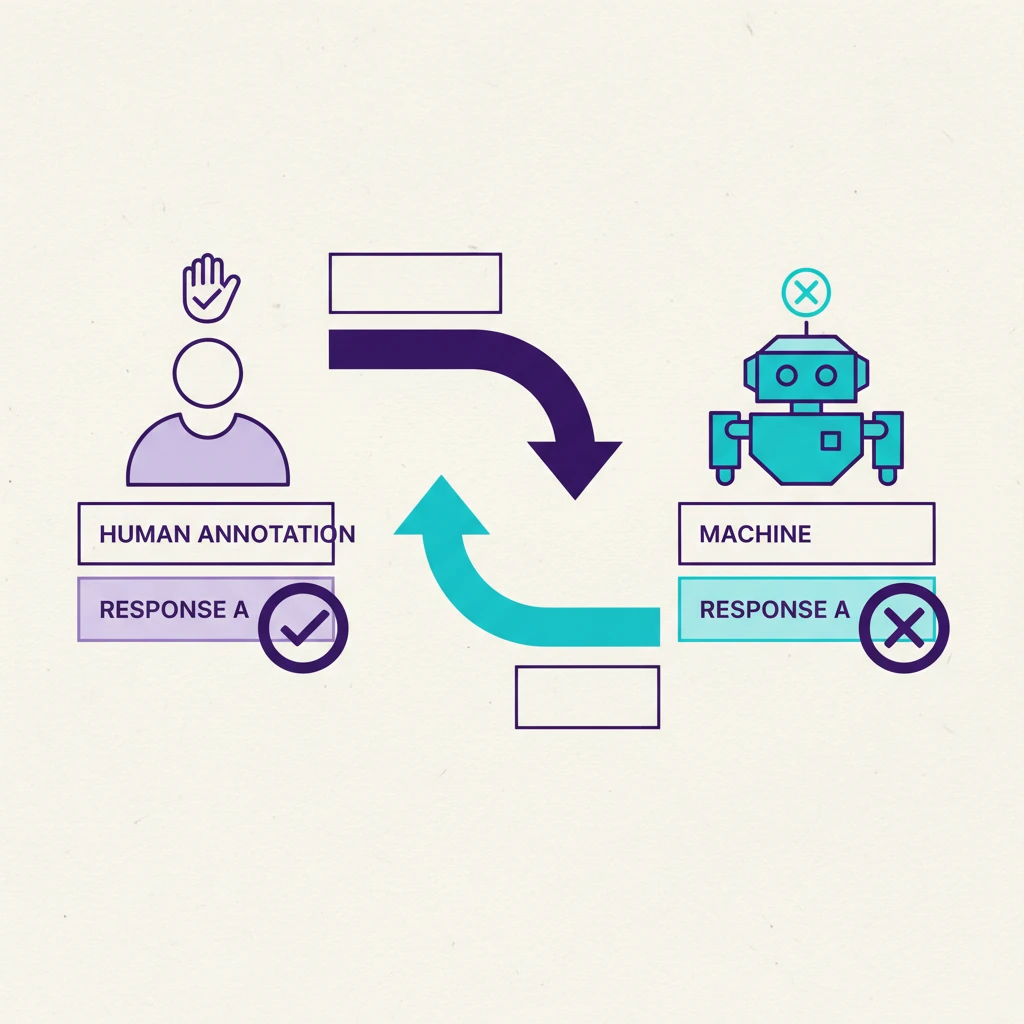
To effectively track trends, it's essential to calibrate LLM judges against human evaluators. This ensures that the automated evaluation process aligns with human judgment, providing a more accurate assessment of model performance. Moreover, feeding production failures back into the evaluation dataset as permanent test cases enables the model to learn from its mistakes and improve over time.
To identify regression signals from trend data versus point-in-time scores,
When evaluating large language models (LLMs), it's crucial to recognize that no single model dominates across every metric or scenario; each model exhibits unique trade-offs [Medium]. Open-source models like Mistral, LLaMA 2, and Falcon are improving rapidly but still lag in nuanced reasoning and multilingual robustness. For example, Mistral 7B excels at code generation but struggles with multilingual reasoning, while LLaMA 2 70B performs well on safety benchmarks but has higher latency. A team deploying a multilingual chatbot would need to prioritize Mistral's weakness, not its strength—a trade-off that static benchmarks cannot capture.
Static benchmarking becomes obsolete as models update weekly or daily; continuous evaluation pipelines are needed to ensure models perform as expected in real-world scenarios. This is because models can degrade over time, and their performance can vary significantly depending on the specific use case. A benchmark from last month may not reflect the current behavior of a frequently updated model like GPT-4o.
In order to choose the right evaluation strategy for your LLM, you need to consider the trade-offs of each model and the deployment context. For instance, you may need to prioritize performance on a specific task or metric, or ensure that the model is robust to certain types of input or bias.
When it comes to evaluating LLMs, there is no one-size-fits-all approach. The right evaluation strategy will depend on your specific use case, the model trade-offs, and the deployment context.
LLM behavior is context-dependent in ways that unit tests cannot capture. For example, a model might pass all unit-test-style evals but fail when the prompt includes a user's name due to tokenization differences. Unlike deterministic code, a passing score can hide regressions in safety or data handling. To catch these edge cases, version your evaluation artifacts and link them to release decisions—just like production code.
Set up a CI job that runs your golden dataset on every pull request. If the pass rate drops below the threshold (e.g. 95%), automatically block the PR and require a human reviewer to inspect the regression. This prevents silent degradation. Also, calibrate your thresholds using a small set of human-labeled examples before gating any release—aim for a false positive/negative rate under 5%.
Build a balanced test set of 100 requests: 50 harmful (should be refused) and 50 harmless (should be accepted). Run the model and compute false negative and false positive rates. If either exceeds 5%, recalibrate refusal thresholds or adjust prompt templates. Be aware that LLM judges themselves have biases—for instance, they may be overly lenient on refusal tasks if the prompt is phrased as a question. Cross-validate with multiple judges or human raters.
Track trends, not points. A single score like 0.85 is meaningless without context—what matters is whether it has dropped from a baseline of 0.91 over the past three weeks. Trend tracking is especially important when you update the model's system prompt; a small change can cause a large shift in behavior that a single score would miss. Use a control chart to visualize trends over time, and feed production failures back into your evaluation dataset as permanent test cases.
Understand how GraphQL resolvers fetch data, the N+1 problem's real impact, and how DataLoader with batching and caching solves it in production.

Learn to build production-grade autonomous AI agents from scratch. This 5-stage roadmap covers orchestration, reliability, and Python code for Indian...

RAG or fine-tune? The real skill that gets you hired is understanding both. This myth-buster reveals demand data, accuracy benchmarks, and cost insights for...


