Cantilever Logo
    Home
    Features
    Blogs
    About Us
    Log In
    Preparation

    RAG or Fine-Tune — The Real Skill That Gets You Hired

    10 min read
    Jul 12, 2026
    RAG or Fine-Tune — The Real Skill That Gets You Hired

    Myth: You Must Choose Between RAG and Fine-Tuning

    The debate between Retrieval-Augmented Generation (RAG) and fine-tuning has led to a common misconception that one must choose between the two. This myth likely stems from the differing strengths of each approach: RAG excels in dynamic applications with frequently changing information, while fine-tuning is ideal for stable domains requiring high accuracy and domain expertise.

    Reality: Complementary Approaches

    In reality, RAG and fine-tuning are complementary approaches that can be used together to achieve better results. According to Matillion, RAG is suitable for dynamic applications like customer support, where information changes frequently or needs to be retrieved in real-time. On the other hand, fine-tuning shines in scenarios where accuracy, domain expertise, and tailored performance are non-negotiable for specific, stable domains.

    Ideal Use Cases

    The ideal use case for each approach depends on the specific requirements of the project. A hybrid approach often delivers the best results: start with RAG for immediate value and broad coverage, then selectively fine-tune models for high-volume or performance-critical workflows.

    CriteriaRAGFine-Tuning
    Domain ApplicabilityDynamic applications (e.g. customer support)Stable domains (e.g. financial analysis)
    Information RequirementsFrequently changing or real-time informationStatic or well-defined knowledge
    Accuracy RequirementsHigh recall, potentially lower precisionHigh accuracy and domain expertise
    Implementation ComplexityGenerally simpler to implementMore complex, requires significant domain expertise

    By understanding the strengths and weaknesses of each approach, developers can make informed decisions about when to use RAG and when to use fine-tuning, ultimately leading to more effective AI solutions.

    Two data scientists in a modern office, one pointing at a monitor displaying a graph with two curves: one labeled 'Fine-Tuned Model Accuracy' dropping over time, and another labeled 'RAG Accuracy' staying high, with a thought bubble showing 'Accuracy depends on context'. - illustration
    Two data scientists in a modern office, one pointing at a monitor displaying a graph with two curves: one labeled 'Fine-Tuned Model Accuracy' dropping over time, and another labeled 'RAG Accuracy' staying high, with a thought bubble showing 'Accuracy depends on context'. - illustration

    Myth: Fine-Tuning Guarantees Better Accuracy

    The notion that fine-tuning guarantees better accuracy is a common misconception in the AI community. Many believe that fine-tuning a pre-trained model on a specific dataset will automatically lead to better performance and higher accuracy. However, the reality is more nuanced.

    Reality: RAG Outperforms Fine-Tuning on Factual Accuracy

    Studies consistently show that Retrieval-Augmented Generation (RAG) outperforms fine-tuning on factual accuracy for knowledge-intensive tasks contextual.ai. When the answer exists in a document, RAG retrieves it, whereas fine-tuning hopes the model has learned it. For enterprise knowledge applications requiring factual accuracy, studies have found that RAG can outperform fine-tuning on factual accuracy for some knowledge-intensive tasks, particularly when answers depend on information that exists in external documents.

    This comparison highlights the strengths of RAG in achieving higher factual accuracy and providing attribution, making it a more reliable choice for applications that require precise information retrieval and transparency. While fine-tuning excels in domain-specific style and consistency, RAG's ability to retrieve exact source information makes it a better option for knowledge-intensive tasks.

    Myth: RAG Is Too Slow for Real-World Applications

    The notion that RAG (Retrieval-Augmented Generation) is too slow for real-world applications stems from the multi-step nature of the RAG process, which includes embedding, searching, ranking, retrieving, and generating. This process inherently adds latency compared to a direct fine-tuned model call.

    Reality: Understanding Latency Trade-Offs in RAG and Fine-Tuning

    RAG's multi-step retrieval process does introduce additional latency. However, this latency can be mitigated through caching opportunities in both the retrieval and prompt output steps. According to Heavybit, RAG users may observe higher inference latency due to the combination of both retrieval and generation.

    In contrast, fine-tuning provides a faster inference path because it only requires a single generation step after the model has been fine-tuned. This is beneficial for latency-sensitive applications. However, fine-tuning also means that the model needs to be re-trained whenever the underlying data or domain changes, which can be resource-intensive.

    Latency Trade-Offs and Caching Strategies

    When evaluating RAG and fine-tuning for real-world applications, it's crucial to consider the trade-offs between latency, caching opportunities, and the need for up-to-date data or traceability.

    Knowledge Check

    What is a primary advantage of using RAG over fine-tuning in applications where data freshness is crucial?

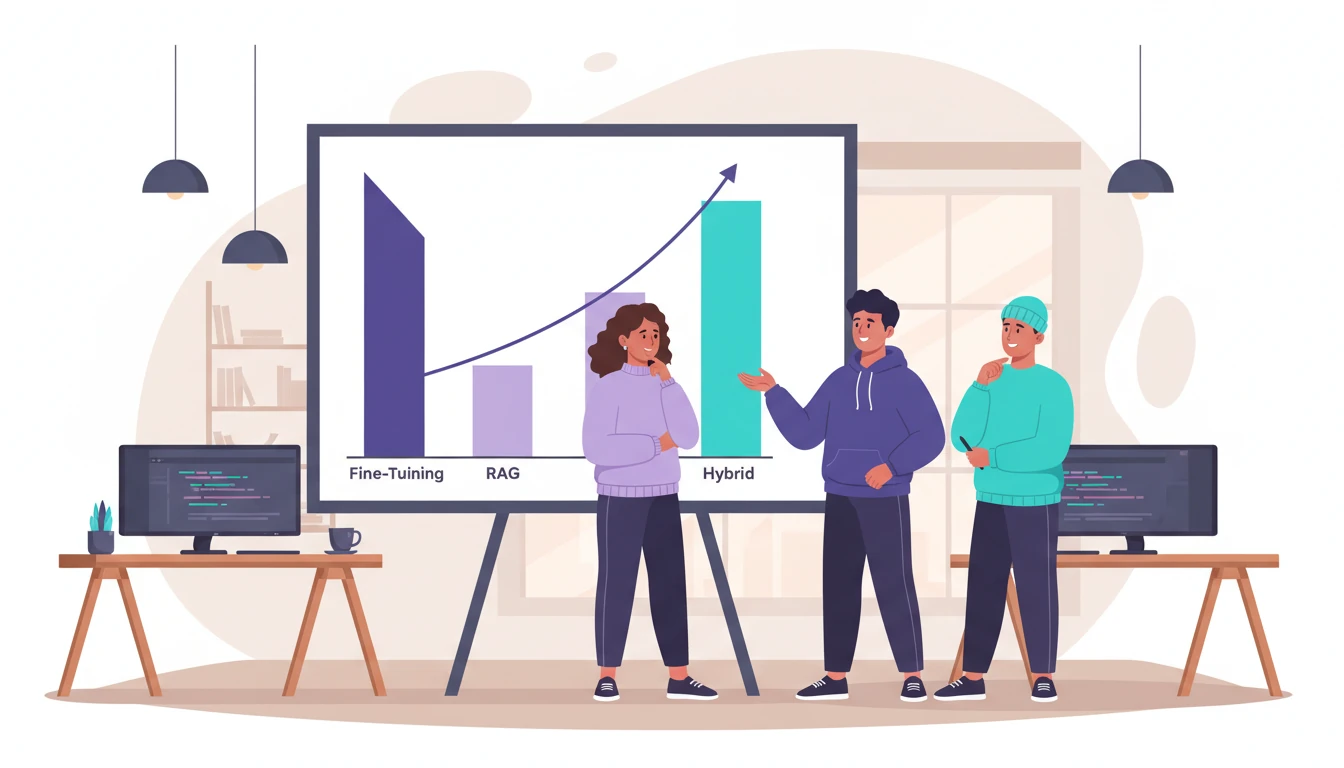
    A team of three engineers around a whiteboard with a cost comparison graph: 'Fine-Tuning' shows high upfront cost, 'RAG' shows lower upfront but higher ongoing cost, and a third bar 'Hybrid' shows balanced cost. One engineer says 'Cost depends on use case'. - illustration
    A team of three engineers around a whiteboard with a cost comparison graph: 'Fine-Tuning' shows high upfront cost, 'RAG' shows lower upfront but higher ongoing cost, and a third bar 'Hybrid' shows balanced cost. One engineer says 'Cost depends on use case'. - illustration

    Myth: Fine-Tuning Is Too Expensive for Most Teams

    Reality: A Balanced View of Fine-Tuning and RAG Costs

    The notion that fine-tuning is too expensive for most teams stems from the high upfront costs associated with this approach. Fine-tuning requires significant investment in data labeling and computational resources, such as GPUs or TPUs, to train the model. However, once the fine-tuning process is complete, the model can be used with standard inference costs.

    In contrast, Retrieval-Augmented Generation (RAG) saves on training costs but incurs ongoing expenses for maintaining infrastructure and performing retrieval for each query. To accurately assess the cost-effectiveness of fine-tuning versus RAG, it's essential to consider the total cost of ownership.

    Cost Comparison: Upfront Training vs. Ongoing Inference Infrastructure

    When evaluating the costs of fine-tuning and RAG, two primary factors come into play: upfront training expenses and ongoing inference infrastructure costs. Fine-tuning demands a substantial initial investment in data labeling and computational resources. On the other hand, RAG involves ongoing costs for infrastructure maintenance and query processing.

    By considering these factors, teams can make informed decisions about which approach best aligns with their resources and goals. While fine-tuning may require significant upfront investment, it can provide long-term cost savings and improved performance. Conversely, RAG offers lower initial costs but may incur higher ongoing expenses.

    Ultimately, the choice between fine-tuning and RAG depends on a team's specific needs, resources, and priorities. By understanding the cost implications of each approach, teams can make strategic decisions that support their AI initiatives.

    Myth: Employers Only Want One AI Skill

    The demand for AI skills has surged significantly, with LinkedIn data showing a 142% increase in AI job postings over the past year, up from 68% growth the previous year resources.rework.com. This rapid growth has led to a common misconception that employers only want one AI skill. However, the reality is that employers are looking for professionals with a deep understanding of multiple AI skills.

    Reality: Employers Seek Comprehensive AI Skill Sets

    A closer look at AI Product Manager job postings reveals that employers are looking for a broad combination of product, technical, analytical, and leadership skills. An analysis of 250 AI PM job postings identified four major skill areas: AI Product Strategy & Lifecycle (94%), Gen AI Technical Depth (89%), Metrics, Evals & AI GTM (84%), and Cross-Functional AI Leadership (78%) linkedin.com.

    AI Skill AreaDescriptionJob Posting Requirements
    AI Product Strategy & LifecycleDefine AI/ML product vision, strategy, and roadmaps from 0→1 through scale94%
    Gen AI Technical DepthUnderstand LLMs, transformers, RAG, fine-tuning, prompt engineering, and multi-agent systems89%
    Metrics, Evals & AI GTMDefine success metrics, build evaluation frameworks, and drive go-to-market for AI features84%
    Cross-Functional AI LeadershipCollaborate with AI engineers, data scientists, designers, and business teams to ship AI products78%

    This analysis shows that employers are looking beyond individual AI techniques such as RAG or fine-tuning. Strong AI product candidates are expected to combine technical depth with product strategy, evaluation skills, metrics, and cross-functional leadership.

    By recognizing the demand for comprehensive AI skill sets, professionals can position themselves for success in the rapidly evolving AI job market. Rather than focusing on a single AI skill, job seekers should aim to develop a combination of technical knowledge, product judgment, evaluation skills, and cross-functional collaboration.

    Myth: Knowing One Technique Is Enough to Get Hired

    Reality: A Hybrid Approach and Continuous Learning Are Key

    The myth that knowing one technique is enough to get hired in the AI engineering field persists, but the reality is that a hybrid approach combining multiple techniques, such as Retrieval-Augmented Generation (RAG) and fine-tuning, is often the most effective way to tackle complex problems. Moreover, the field of AI is rapidly evolving, making continuous learning a crucial aspect of career growth.

    In the context of AI skills demand, particularly looking ahead to 2026, it's essential to understand that employers are seeking professionals who can strategically decide when to apply different techniques. This involves not just technical expertise but also the ability to assess problems and choose the right tools.

    Strategic Decision-Making for Comprehensive Skill Sets

    To navigate the complex landscape of AI techniques and stay relevant, aspiring and current AI engineers must focus on developing a comprehensive skill set. This doesn't mean becoming an expert in every technique but rather understanding the strengths, weaknesses, and ideal use cases for various approaches.

    Continuous Learning in AI Engineering

    Given the rapid pace of advancements in AI, continuous learning is not just beneficial but necessary for career growth. This involves staying updated with the latest research, learning new techniques, and understanding how to apply them effectively in real-world scenarios.

    The demand for AI skills is expected to grow significantly by 2026, with various reports suggesting that the field will continue to evolve, introducing new techniques and methodologies. Therefore, professionals aiming to succeed in this field must adopt a mindset geared towards continuous learning and adaptability.

    By focusing on strategic decision-making and continuous learning, individuals can develop a comprehensive skill set that not only makes them more attractive to potential employers but also positions them for long-term success in the rapidly evolving field of AI engineering.

    Frequently Asked Questions

    How do I decide whether to learn RAG or fine-tuning first for a job in AI?

    Start with RAG. It is the default architecture for most enterprise AI applications, and studies consistently show RAG outperforms fine-tuning on factual accuracy for knowledge-intensive tasks. RAG also gives you immediate value and broad coverage, while fine-tuning is best reserved for high-volume or performance-critical workflows. Once you master RAG, selectively fine-tune for specific domains—the hybrid approach is what actually gets deployed in production.

    Does RAG actually perform worse than fine-tuning in terms of latency and cost?

    Not necessarily—it depends on your use case. RAG introduces multi-step inference (embed, search, rank, retrieve, generate) which adds latency compared to a direct fine-tuned model call, but caching opportunities exist in both retrieval and prompt output steps. Fine-tuning has high upfront costs in computation and data labeling, while RAG incurs ongoing retrieval infrastructure expenses. For dynamic applications like customer support, RAG’s traceability and up-to-date data outweigh the latency tradeoff; for latency-sensitive static tasks, fine-tuning may be faster.

    Do employers prefer candidates who specialize in one technique over the other?

    No—employers demand breadth, not specialization. LinkedIn data shows AI job postings surged 142% in the 12 months through Q1 2026, with prompt engineering, Python, SQL, machine learning, RAG, and MLOps leading the in-demand skills list. An analysis of 250 AI product manager job postings found that 89% require deep understanding of LLMs, transformers, RAG, fine-tuning, and multi-agent systems. Employers value candidates who understand both techniques and know when to use each—or combine them in a hybrid approach.

    Is it true that knowing RAG and fine-tuning alone is enough to get hired?

    No—hiring managers look for practical judgment as much as technical skill. The myth that one technique is enough is debunked by the reality that AI roles increasingly require context engineering, multi-agent architecture, and the ability to decide when not to use AI. A hybrid approach and continuous learning are key: 51% of AI-related job postings are now outside traditional IT roles, meaning you also need domain knowledge. Employers want engineers who can start with RAG for coverage, selectively fine-tune for performance, and trace results back to source documents—skills that prove you can build production-ready systems.

    Table of Contents

    • 1. Myth: You Must Choose Between RAG and Fine-Tuning
    • 2. Ideal Use Cases
    • 3. Myth: Fine-Tuning Guarantees Better Accuracy
    • 4. Myth: RAG Is Too Slow for Real-World Applications
    • 5. Myth: Fine-Tuning Is Too Expensive for Most Teams
    • 6. Myth: Employers Only Want One AI Skill
    • 7. Myth: Knowing One Technique Is Enough to Get Hired
    • 8. Frequently Asked Questions
    Build ATS Friendly Resume
    Check Resume ATS Score
    Industry Level Projects
    Interview Playbook
    Dream Company Track

    Build ATS Friendly Resume

    Use our AI Resume builder to tailor your resume with 10+ ATS Friendly templates.

    Check Resume ATS Score

    Find and fix hidden issues and gaps instantly to make sure your resume survives recruiter filters.

    Industry Level Projects

    Explore a curated project library personalized to your role and resume to bridge skills gap.

    Interview Playbook

    Master your preparation with our famous frameworks to prepare for your next interview.

    Dream Company Track

    Follow a step-by-step prep roadmap tailored around the hiring process of your target company.

    Keep Reading

    View all
    LLM Evals or Unit Tests? — Why Your CI Pipeline Is Lying
    01
    Preparation

    LLM Evals or Unit Tests? — Why Your CI Pipeline Is Lying

    Discover why treating LLM evaluations like unit tests creates false security in CI/CD pipelines. Learn regression-testing discipline and metric validation...

    12 min read•Preparation Module
    How a GraphQL Resolver Fetches Data Under the Hood
    02
    Preparation

    How a GraphQL Resolver Fetches Data Under the Hood

    Understand how GraphQL resolvers fetch data, the N+1 problem's real impact, and how DataLoader with batching and caching solves it in production.

    12 min read•Preparation Module
    Building Autonomous AI Agents from Scratch: The 5-Stage Production Roadmap & Python Code
    03
    Preparation

    Building Autonomous AI Agents from Scratch: The 5-Stage Production Roadmap & Python Code

    Learn to build production-grade autonomous AI agents from scratch. This 5-stage roadmap covers orchestration, reliability, and Python code for Indian...

    13 min read•Preparation Module
    4th Floor, Bizness Square, Opp. Hitex Charminar, Hitec City, Hyderabad - 500081
    (684) 555-0102
    Site Map
    Home
    About Us
    Features
    Blogs
    Others
    Privacy Policy
    Terms and Conditions
    Careers
    Media Coverage
    Subscribe to get latest updates
    Follow us on:
    ©2026 Cantilever Labs Pvt. Ltd. | info@cantileverlabs.com